INSIGHTS FOR B2B SAAS
Website Growth, Decoded
Practical thinking on positioning, conversion, SEO, and AI visibility for B2B SaaS companies.
LATEST ARTICLES

SaaS Growth
Website Copy
How to turn website copy into a clearer, more convincing growth system
TL;DR
Good SaaS website copy starts before the writing. Get clear on the ICP, positioning, page jobs, and buyer journey first.
Your copy should answer three questions quickly: what you do, who it is for, and why the buyer should care.
Write for scanners: short paragraphs, descriptive headings, bullets, bold emphasis, and one clear idea per section.
Treat SEO and AI discoverability as part of the system, not as a layer added after the copy is written.
Use AI for speed and exploration, but keep strategic decisions, customer understanding, claims, and final editing human.
Judge copy by business outcomes and buyer clarity, not by whether the marketing team thinks it sounds polished.
This guide builds on Upleadium's broader approach to website growth: positioning and messaging first, then structure, content, search and AI discoverability, and conversion.
What Is Website Copywriting, and Why Do Most SaaS Companies Get It Wrong?
Website copywriting is the text on a website that helps visitors understand what you offer, why it matters to them, and what to do next. For a B2B SaaS company, that includes the homepage, product and feature pages, pricing, About, landing pages, navigation labels, CTAs, forms, and supporting content.
The important distinction is that website copy is not decoration. It has a job. It should help the right buyer recognise a relevant problem, understand your approach, see enough evidence to trust it, and take the next sensible step.
Many SaaS websites fail because they start from the company's point of view. The page leads with a product name, internal terminology, feature list, or broad promise before the visitor has enough context to care.
A product name is not positioning. A first-time visitor may not know what category you are in or why the product matters.
A feature list is not a value proposition. Buyers care about the work the feature helps them do and the outcome it supports.
A clever headline is not clarity. If the buyer has to decode it, the copy has already made the job harder.
More copy is not automatically more persuasion. Extra words can hide the important point instead of strengthening it.
The better model is a connected system: Positioning → Messaging → Structure → Content → SEO / AI Discoverability → Conversion. The words matter, but they work best when the decisions upstream are sound.

The core Upleadium website-growth system: copy works inside a larger chain of strategic decisions.
What Comes Before the Writing
The most useful copywriting work often happens before the first headline is drafted. If the audience is vague, the positioning is interchangeable, or the page structure is wrong, polished writing will not rescue the page.
1. Know Your Ideal Customer Profile
“B2B SaaS companies” is a market category, not a useful copy brief. You need enough detail to understand who is arriving, what they are trying to accomplish, and what makes them hesitate.
Role: Who is evaluating the product or influencing the decision?
Company context: What type of business, stage, team, or operating environment are they in?
Problem: What is frustrating, expensive, risky, slow, or unclear today?
Desired outcome: What does better look like in practical terms?
Current workaround: What are they doing instead, and why is it not good enough?
Objections: What could make them pause, delay, or choose another option?
Language: What words do customers actually use to describe the problem?
That last point matters. Customer language is often more useful than internal product language. Pull wording from sales calls, support conversations, demos, reviews, win/loss notes, onboarding questions, and customer interviews when you have access to it.
2. Nail Your Positioning
Positioning establishes what your product is, who it is for, the problem it solves, and why a buyer should choose it over the alternatives. Copy cannot be clearer than the thinking underneath it.
A useful working sentence is: “For [type of customer] who needs to [job or outcome], our product helps them [specific value], unlike [current alternative] because [reason to believe].”
Category: What should the buyer understand you are?
Audience: Who is the strongest fit?
Problem: What meaningful problem are you solving?
Value: What changes for the customer?
Differentiation: Why you rather than the obvious alternative?
Proof: What makes the promise believable?
3. Map Your Pages to the Buyer Journey
Different pages have different jobs. The homepage creates orientation and trust. Product pages explain the mechanism. Pricing reduces uncertainty. Landing pages turn a specific source of traffic into a specific action.
Homepage: What do you do, who is it for, and why should I care?
Product / features: How does it solve the problem, and why should I believe it?
Pricing: What do I get, which option fits, and what risk or friction remains?
About: Why does this company exist, and why should I trust it?
Landing page: Why should I take this one next step from this one traffic source?

The strategic foundation: the closer the copy gets to the surface, the more useful the upstream decisions become.
Page-by-Page Website Copywriting Breakdown
Homepage
Your homepage has to answer three questions quickly: What do you do? Who is it for? Why should I care? The first screen should usually include a clear headline, supporting sentence, and primary CTA.
Lead with the problem or outcome. Do not make the visitor decode a product name before they understand the value.
Use “you get” language. Focus the copy on the buyer's situation rather than “we are” statements.
Put relevant proof near the top. Customer names, credible outcomes, certifications, or clear product scope can reduce uncertainty.
Make the CTA concrete. Tell people what happens next rather than hiding behind “Learn more.”
Weak: “Meet FlowPilot, the next generation of operations intelligence.”
Stronger: “Give your operations team one place to see what is slowing work down.” The second version starts with a recognisable job instead of a category claim.
Product and Feature Pages
A feature name rarely explains why a buyer should care. Translate capabilities into the work they help the customer do, then show the mechanism that connects the feature to the outcome.
Problem: Start with the pain the buyer already recognises.
Solution: Explain what the product does and how it addresses the problem.
Proof: Add evidence, examples, product detail, or customer evidence.
One idea per section: Do not combine several unrelated product benefits into one dense block.

A simple section pattern for product and feature copy: understand the problem, explain the response, then prove the promise.
Pricing Page
A pricing page is not just a list of numbers. It helps buyers decide which option fits, what is included, and what risk comes with the purchase.
Make plan differences easy to understand. Avoid forcing buyers to compare tiny feature variations.
Address cancellation and change questions. Buyers often want to know what happens if their needs change.
Explain limits and implementation. Be clear about usage limits, onboarding, support, and what is included.
Use proof where uncertainty is highest. Testimonials, customer logos, security information, or implementation details can matter here.
About Page
A useful About page is not a company biography with the customer squeezed in at the end. Explain what led the company to focus on the problem, what it believes about the space, and why that matters to the people considering the product.
Start with the customer problem. The origin story should explain why the company exists.
Show relevant expertise. Give buyers a reason to believe you understand the problem.
Keep the story useful. Remove history that does not help the buyer trust or understand the business.
Landing Pages
A landing page should have one primary goal. Match the opening message to the source of traffic, continue the promise that prompted the click, and make the next action obvious.
One audience or use case. Keep the page specific enough that the visitor immediately recognises relevance.
One core promise. Repeat and support the same value proposition rather than introducing five new ones.
One primary CTA. Secondary navigation can exist, but it should not compete with the conversion goal.
Repeat the CTA at useful moments. Reinforce the action after the key questions have been answered.
How to Write Website Copy That Actually Converts
Write for Scanners First
People do not usually read a webpage from top to bottom. They scan, look for relevant signals, and decide where to spend attention. Nielsen Norman Group research has repeatedly documented this behaviour and recommends meaningful headings, bullets, highlighted keywords, front-loaded information, and concise writing. See the NN/g research on how people read on the web
Front-load the point. Put the important information early in the sentence and section.
Use descriptive headings. The heading should tell the reader what they will get from the section.
Break up dense blocks. Use bullets when the information is genuinely list-like.
Use bold selectively. Highlight the words a scanner should not miss.
Keep paragraphs focused. One main idea is easier to scan and easier to understand.
Use Clear, Specific Language
Replace broad promises with a clear description of the problem, action, or result. “Work smarter” tells a buyer almost nothing. “Bring CRM and billing data into one report without manual exports” gives them something concrete to evaluate.
Prefer concrete nouns and verbs. Say what the product does instead of describing it with layers of adjectives.
Avoid invented precision. Never add a performance number just because it sounds persuasive.
Use customer language. If buyers call it “manual reporting,” do not replace that phrase with an abstract internal term.
Give Every Section One Job
Before writing a section, finish this sentence: “After reading this, the visitor should understand…” If the answer contains several unrelated ideas, split the section.
Clarify one thing. Each section should remove a specific question or uncertainty.
Move the buyer forward. The sequence should make the next section easier to understand.
Do not repeat the same promise everywhere. Repetition should reinforce a decision, not create noise.
Use CTAs That Explain the Next Step
“Learn more” is vague when you can describe the action directly. “See the product in action,” “Compare plans,” or “Get a free website growth audit” helps the visitor understand what will happen next.
Match the CTA to intent. A high-intent visitor may want a demo; an earlier-stage visitor may need a guide or comparison.
Make the action specific. The label should communicate the next step, not just the existence of another page.
Reduce uncertainty. Where useful, add a short explanation of what happens after the click.
Website Copywriting and SEO
Good website copy and SEO are not competing goals. Search helps the right people find a page; clear copy helps them understand it once they arrive.
Google's current guidance emphasises helpful, reliable, people-first content and makes clear that the main content of a page should directly help it achieve its purpose. Read Google's guidance on creating helpful, reliable, people-first content
Start with search intent. Understand what the person is trying to accomplish, not just the keyword they typed.
Use the primary topic naturally. Put it in the title, opening, and relevant headings where it genuinely fits.
Cover related questions. Add useful context when it helps the reader complete the task.
Write strong title tags and meta descriptions. They are part of the click decision, not just technical SEO fields.
Build useful internal links. Link descriptive phrases to pages that actually deliver on the promise.
For Upleadium, that means connecting the article naturally to the Upleadium website when readers want the broader website-growth approach, and to the free website growth audit when they are ready for a practical review.
AI and Website Copywriting in 2027
By 2027, AI-assisted writing is normal. That does not make strategic copywriting automatic.
AI is useful for generating first drafts, exploring headline directions, grouping ideas, summarising approved research, and getting past a blank page. It is much weaker at understanding your buyer deeply, making positioning decisions, deciding what to cut, protecting a distinctive voice, and knowing whether a claim is actually supported.
Use AI for speed. Brainstorm alternatives, outline sections, summarise approved inputs, and surface repetition.
Use humans for judgment. Decide what matters, what differentiates you, what is credible, and what should be removed.
Give AI real inputs. Customer language, product facts, approved proof, brand guidance, and page goals produce better starting points.
Edit hard. Remove generic phrases, unsupported claims, repetitive sections, and language that no real buyer would use.
Keep the source of truth human. AI should not quietly invent customer evidence, product capabilities, or performance claims.
The 2027 rule of thumb
AI can help you make more copy faster. Your job is still to make sure you are saying the right thing to the right buyer. That strategic distinction matters more than ever as generic AI-written content becomes easier to produce.
How to Know If Your Website Copy Is Working
Copy performance should be judged against the job of the page, not by whether the marketing team likes the writing.
High exits or weak engagement on an important page. Especially when the page is receiving relevant traffic.
Visitors rarely move beyond the opening section. A warning sign when the page needs more explanation to convert.
Low conversion on a high-traffic page. If the right people arrive but do not act, inspect the message and next step.
Sales keeps re-explaining the product. Repeated questions about what you do, who it is for, or why it matters can reveal a messaging problem.
Internal teams disagree on the main message. If product, sales, and marketing describe the company differently, the website will usually reflect that confusion.
None of these signals proves that copy is the problem by itself. Traffic quality, page speed, form friction, offer strength, product fit, and the broader buying process can all affect conversion. The point is to use the data as a reason to investigate, not as a reason to blame the copy automatically.
Run the Five-Second Test
Show your homepage to someone who has not seen it before. Give them five seconds, then ask:
What does this company do?
Who is it for?
Why might it matter to them?
What would you do next?
If the answers are vague, wrong, or wildly different from your intended message, the page probably needs more than a copy polish.
A Practical Website Copywriting Framework
If you need a repeatable process, use this six-step sequence. It keeps the work upstream enough to avoid polishing the wrong message.
Define the buyer. Write down the specific audience, problem, context, desired outcome, alternatives, and objections.
Clarify the positioning. State what you are, who you are for, the problem you solve, and why you are different.
Give each page a job. Define the main question the page should answer and the action it should support.
Build the message hierarchy. Decide the primary promise, supporting points, proof, objections, and CTA.
Write and edit for scanning. Use short paragraphs, clear headings, bullets, bold emphasis, and specific language.
Measure and improve. Look at qualified traffic, engagement, conversion, sales feedback, and search performance, then revise.
The upstream principle
If the copy is not working, do not immediately rewrite the copy. Check the positioning, audience, page job, proof, and conversion path first.
What Website Copywriting Cannot Fix
Copy is powerful, but it is not a universal repair kit. If the underlying offer, audience, product experience, or website structure is weak, better sentences may only make the problem sound nicer.
Unclear positioning. If you cannot explain why you are the right choice, the copy will struggle to create differentiation.
A weak offer. Clear writing cannot make an unattractive commercial proposition compelling.
Poor product-market fit. Copy can clarify value, but it cannot manufacture genuine demand.
Broken conversion paths. A strong CTA cannot compensate for a confusing form, weak handoff, or bad next step.
A fragmented website structure. Great sections still feel confusing when the overall journey does not make sense.
Website Copywriting Services: Where This Work Fits
For B2B SaaS teams, copywriting is most valuable when it is connected to the wider website problem. That is why Upleadium approaches website growth as a system rather than treating copy as an isolated deliverable.
Positioning and messaging: clarify the strategic story before writing pages.
Website structure: decide which pages exist, what each one does, and how users move between them.
Conversion: connect the message to the next action and remove avoidable friction.
Search and AI discoverability: make useful content easier for search engines, users, and LLM-driven discovery to understand.
Implementation-ready copy: turn the strategy into pages your team can actually ship.
If you want a practical second opinion, start with Upleadium's free website growth audit. It looks across messaging, structure, conversion, content, and discoverability.
Further Resources
Upleadium for the broader website-growth approach.
Upleadium's free website growth audit for a practical review of messaging, structure, conversion, and discoverability.
Google Search Central: Creating helpful, reliable, people-first content for Google's current guidance on useful content.
Nielsen Norman Group: How People Read on the Web for research on scanning, headings, bullets, and web reading behaviour.
Nielsen Norman Group: Writing Hyperlinks for guidance on descriptive, scannable link text.
Conclusion
The best website copy does not try to sound impressive. It makes the right buyer understand the right thing quickly.
For B2B SaaS companies in 2027, that means going upstream. Start with the buyer and the problem. Clarify the positioning. Give each page a job. Build a message hierarchy. Write for scanners. Connect copy to search and AI discoverability. Then measure what happens and improve it.
In other words, copy is one layer of a website growth system, not the whole system. When the layers work together, the website becomes easier to understand, easier to find, and more useful as part of the sales process.
If you want a second opinion on whether your website copy is doing its job, Upleadium's free website growth audit is the practical next step.

Customer Research
Positioning
Creating an accurate ideal customer profile is crucial. Learn 4 unexpected ways to uncover your perfect customers and sharpen your messaging.
Imagine you’re throwing a party. But you don’t send invites to just anyone - you carefully curate the guest list to ensure the right people show up. That’s what creating an Ideal Customer Profile (ICP) does for your business. An ICP paints a detailed picture of your perfect target customers.
Too many companies rely on lackluster demographics or transactional data often missing out on key insights that make their ICP specific, and tangible. That’s like throwing a blind party.
Meanwhile, startups often have little customer data to work with - also no bueno. Yet being in the dark about your target audience is a scenario you just can’t afford in today’s highly competitive markets.
While most businesses have a general sense of how to conduct basic research about their ideal customers, some of the most valuable insights can be uncovered through less-known but highly effective research methods.
Here are 4 unexpected ways to uncover those eureka moments about your perfect customers that can ultimately sharpen your messaging.
1. Let AI Reveal Your Most Valuable Customers 💻
AI technology has become an absolute no-brainer in the martech toolbox given its ability to automate an enormous amount of manual work. But one of the most exciting AI capabilities I’ve discovered recently is leveraging advanced machine learning algorithms to pinpoint your most profitable ideal customer profiles in minutes.
Early-stage startups in particular often simply don’t have enough historical customer data to thoroughly analyze their existing customer base to define their ICPs in detail. However, using artificial intelligence to hypothesize who your ideal customer profiles likely are can be a perfect time-saving solution. It can also supplement any existing data points you may have about your current buyer personas.
One tool I’ve come across that provides these AI-powered ICP insights is called M1-project. In a nutshell, what M1-project does is analyze key inputs you provide about your product or service offering, and then suggests the highest probability ICPs and associated buyer personas based on that information. Quite amazing, huh?
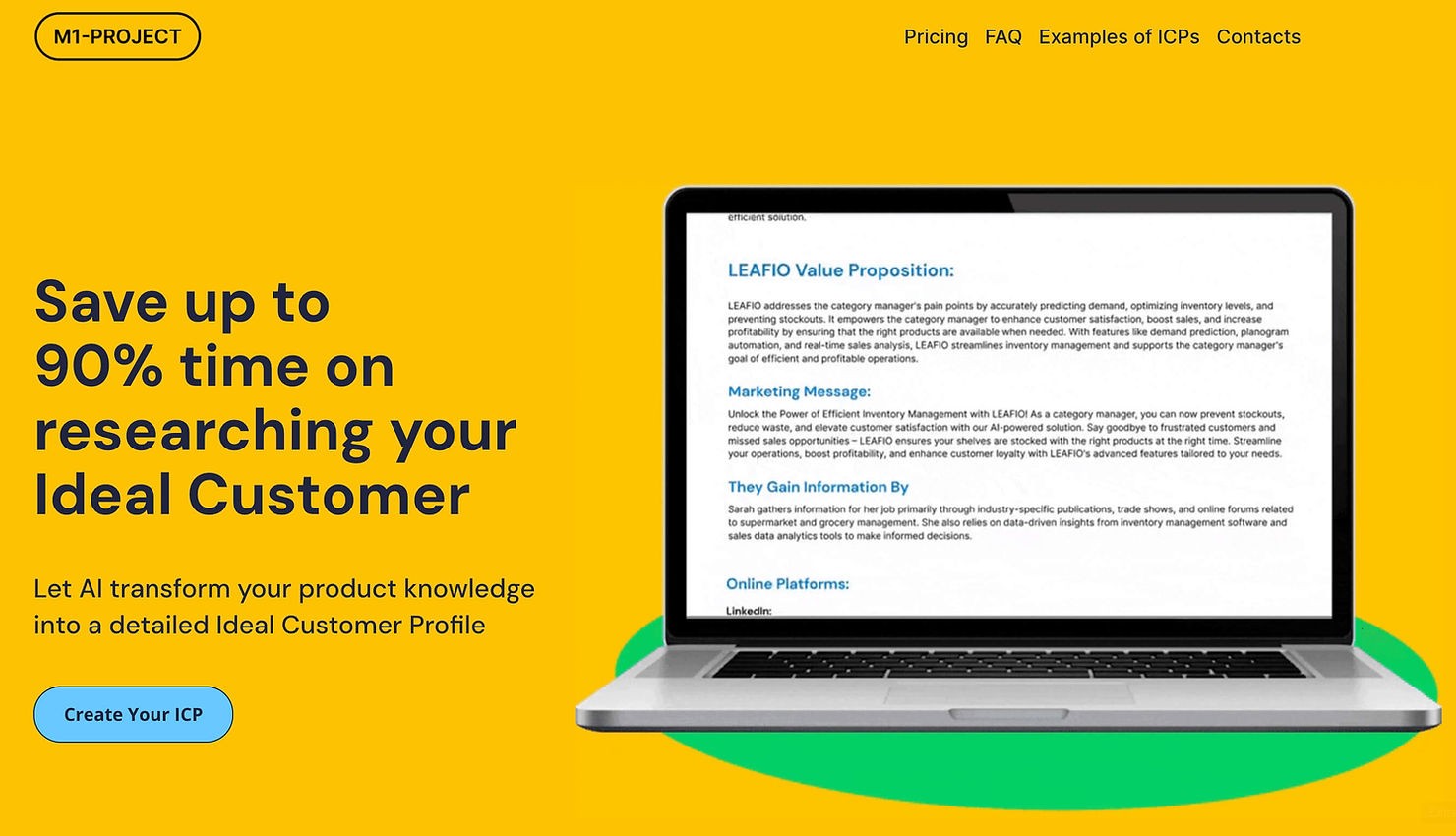
Here’s how it works:
Step 1. Input Essential Data for AI Analysis
Enter foundational data for the AI to analyze, including your website URL, your general business model (B2B, B2C, etc), and specifics on how you intend to use the suggested ICP once created. You’ll also be asked a series of questions about your business, products, and existing customer base that will help the AI gather as much precise, relevant information as possible,
Step 2. Get and Enhance Your Product Description
The AI will then generate an initial draft product description for you. While the heavy lifting is done by the technology, this is where your market expertise comes in. You’ll want to review the product description closely and ensure it accurately captures your key features, benefits, and differentiators. Refine and add any missing details, like calling out a specific geography or industry vertical you may be targeting.
The key thing I learned from testing this tool is that the more precise context and details you can provide to the AI, the better it will be able to dial in an optimized ICP. Add the specifics on your products, services, customers and market that you can. This level of detail is what enables the AI to surface those unexpected insights to build a top-notch ICP tailored to your business.
Step 3. Select Appropriate Needs, Problems and Segments
Next, do the same review for the sections covering customer needs and problems that your product or service aims to solve. The AI will suggest several potential ICP “segments” along with associated buyer personas based on your inputs. You’ll then need to choose the 1 ICP segment that seems the strongest fit. Once you’ve selected your ideal ICP segment, you can then select 1 linked buyer persona. As an example to showcase how the needs are picked up by the AI, I tested out Ahrefs, an SEO tool for marketers. See how precisely the needs are generated:
Step 4. Get Your Detailed ICP and Buyer Persona
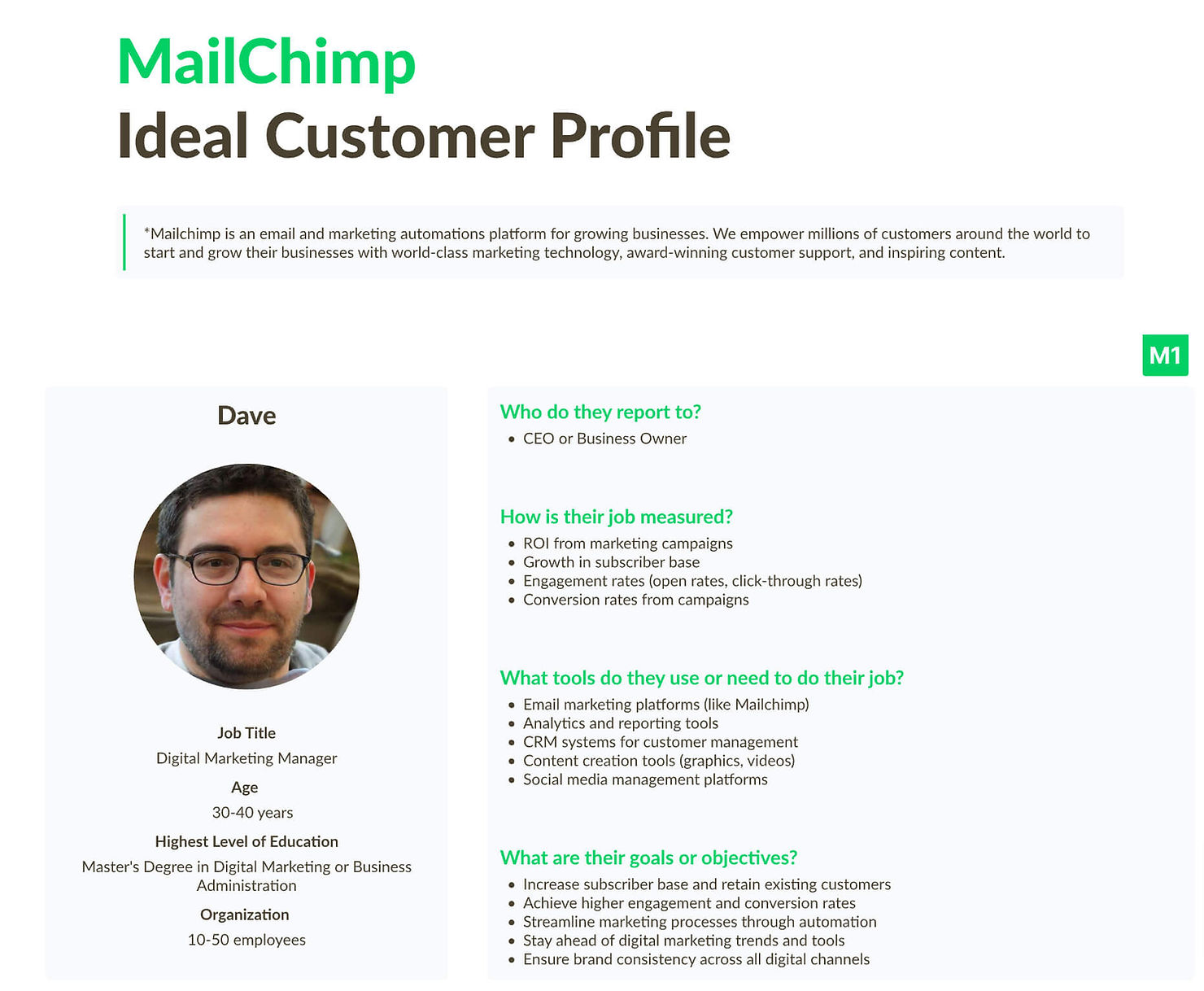
And this is where the magic happens. The tool delivers extensive research on your ICP and chosen buyer persona all in a single downloadable file. It includes comprehensive demographic and psychographic details, professional background information, pain points, goals, and aspirations.
But there’s more - it also surfaces helpful data for building communication like values and fears, behavioral patterns, potential objections, decision-making processes, brand perceptions, and legal considerations. This is a goldmine for marketers
The icing on the cake is the media consumption section showing specific blogs, social media platforms, and LinkedIn groups where your target audience hangs out. It’s incredibly thorough and impressive. This is just a high-level glimpse of how detailed your ICP output can be. I’d recommend trying it yourself via this link to see the full value.
Step 5: Put the new ICP data to use
For new businesses without existing ICPs, this provides an abundance of data to jumpstart your buyer research and personas. For established businesses, you can build upon the suggested profile by blending these new AI-generated insights into your current ICPs to fill gaps and enhance their accuracy.
2. Learn from Competitors’ Customer Reviews 🔎
While learning about your own customers is ideal, your competitors’ customer reviews provide unique insights. These buyers operate in your industry, facing similar issues. Reading these reviews gives an impartial perspective on shared pain points and desires. By incorporating these crowd-sourced insights, you not only improve your ICP but also gain a deeper understanding of your industry’s needs.
Here is a process for putting competitor reviews to work:
Step 1: Pick Your Top 5 Competitors
Choose five big players in your industry. These are the folks whose customers have a lot to say. Usually, there will be plenty of reviews available for these products.
Step 2: Check Out the Reviews
Go on websites like G2, Capterra, and Trustpilot. See what the customers of your competitors are saying. It’s like eavesdropping on what your potential customers want and don’t want. Pay attention to the roles of the people who leave the reviews (if the information is available).
Step 3: Sort and Summarize
Organize the reviews and point out the things that come up a lot. This makes it easier to see the trends and major pain points for users.
Quick tip: AI tools like ChatGPT or Bard can help make a summary, but don’t forget to double-check because sometimes they get things wrong.
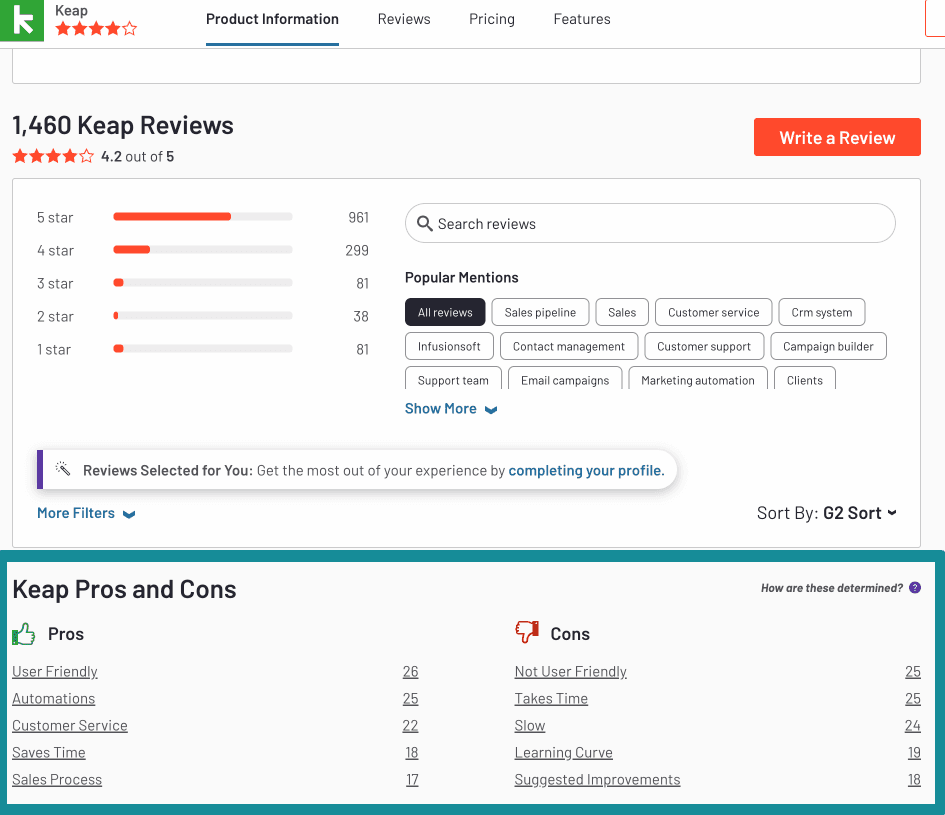
Also, G2 has a section that summarizes the Pros and Cons, as shown in the screenshot below, which is quite convenient.
Step 4: Put These Insights in Your Ideal Customer Profile
Blend these bite-sized insights into your ICP. These aren’t just random thoughts; they’re approved by the same customers who make your competitors popular. This mix ensures your ICP fits the real world of your industry.
Step 5: Turn Competitors’ Problems into Messaging Gold
Spot the common issues and complaints. Turn them into messages that show your product is better at solving these shared problems. This not only makes you different from the rest but also shows your products can handle common industry challenges in a better way. In the example above with Keap, G2 makes it evident that there are specific areas where Keap’s competitors might have an advantage. Therefore, if I were part of a CRM closely competing with Keap, my strategy would be to highlight the ease of use and user-friendliness of our software.
Gleaning intelligence straight from your competitors’ customer bases can provide that insider industry perspective you likely won’t get anywhere else. Use it to level up your ICP accuracy.
3. Profile Your Best Customers on Social Media 🌐
Have you ever wondered what your best customers’ lives are like outside of being a customer? What TV shows do they watch? What hobbies do they have? Imagine if you could go undercover and immerse yourself in their lives.
While you can’t follow them around in real life (that would also be strange 🙂), their social media profiles provide the next best thing - a virtual sneak peek into who they really are.
By digging through their social accounts, you can piece together a clear understanding of your customers’ interests, lifestyle, and attributes. Then, blend these insights into your ICP to make it reflect real people, not just transactions.
Here’s how to use social media to uncover the lives of your ideal customers:
Step 1: Identify Your Customers for Social Media Profiling
Make a list of 5-10 of your most valuable customers. These are the advocates who drive the most revenue, have been customers the longest, or actively promote your brand.
Step 2: Visit Their Various Social Media Profiles
Search for their names on platforms like Facebook, Instagram, Twitter, LinkedIn, and TikTok. Visit each profile and dive in to soak up details.
Step 3: Analyze Photos, Bios, Posts, and More
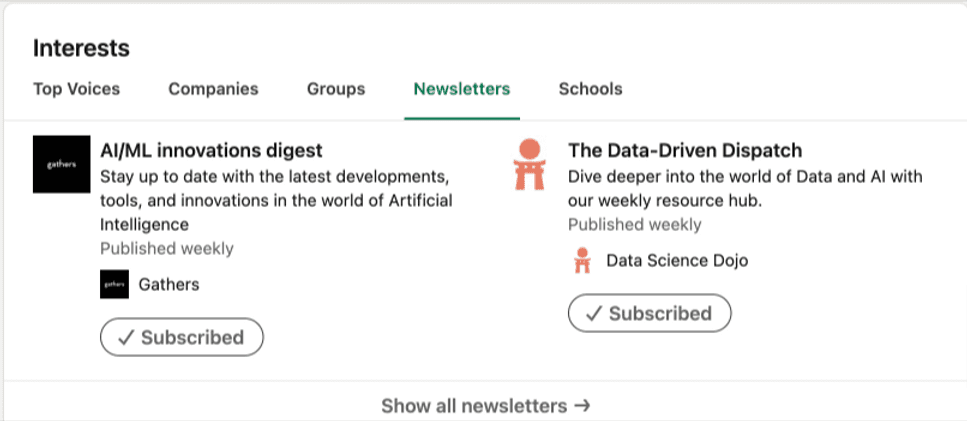
Go beyond just a quick glance. Study their profile photos, bios, recent posts, likes, shared content, causes followed, groups joined, and hashtags used. One particularly useful example is the Newsletter block on LinkedIn. This section explicitly displays the type of content your ICP consumes. Below is a screenshot of this section from my LinkedIn.
Step 4: Note Key Details and Identify Common Interests
Write down specific info like employers, job titles, locations, education, relationship status, etc. Make a list of hobbies, TV shows, causes, sports teams, etc. that come up frequently. Identify common traits among your top customers to create a comprehensive picture.
Step 5: Incorporate Insights into Your ICP
Add the common interests, pain points, beliefs, and demographics into your ideal customer profile. This literally brings your ICP to life.
Getting beneath the surface and into the real lives of your best customers takes some detective work. But putting in this work will uncover a goldmine of insights to strengthen your ICP and marketing.
4. See What Draws Users’ Attention with Heat Maps 🖍
While you can’t be holding your prospect’s hand through their customer journey, there is technology that can certainly help you figure out how they perceive it.
Your website is normally one of the most important (if not the most important) touchpoints, and you can pick up lots of clues about your ICP and buyer persona just by looking at how they consume your website’s content.
Heat mapping software reveals these clues by showing you exactly what your visitors click on during their journey through your site. It’s like having a highlighting tool that makes your customers’ interests light up before your eyes. By analyzing this heat map of engagement, you can uncover your customers’ true interests to enrich your ICP.
Here’s how to explore your website’s heat map:
Step 1: Get Your Virtual Highlighter
Sign up for heat mapping software like Hotjar, CrazyEgg, or Microsoft Clarity. There are many software of this kind you can choose from. I personally love Microsoft Clarity, which has a wonderful free version. Add the small tracking code to your website pages. This allows the software to do its magic.
Step 2: Let Customers Explore
Over a few weeks, customers will naturally browse your site. The software quietly tracks their clicks in the background. Pick several pages that you’d be interested in the most (like the pricing and features page, for instance). Also, you might want to pay closer attention to certain segments, for instance, people who spent 30+ secs on your website.
Step 3: See Their Interactions Highlighted
Check the heat map that visually highlights which sections and pages attract the most clicks. See what draws attention. Make a list of the specific content that gets clicked on the most. For instance, I identified the features that are more interesting to users (they click on those sections more).
Step 4: Add These Insights to Your ICP
Incorporate these customer-validated interests and needs into your ideal customer profile. Let your customers guide you to what matters most to them.
By going beyond basic data, you can uncover a uniquely detailed view of your customers. With a crystal-clear ICP, you can fine-tune your marketing to attract and retain more ideal customers.
Bonus Tip: Hire a Practitioner to Help You with ICP
With 8 years of helping SaaS startups to go from 0 to $3M ARR and more, I’ve started Upleadium to help more businesses with my services. Here’s what I can offer:
🟢 Marketing Audit & GTM Strategy: I conduct a comprehensive audit of your current marketing strategy and programs. Then I develop an optimized go-to-market strategy tailored to your business goals. This includes positioning, messaging, and a roadmap to drive results.
🟢 Fractional CMO services: I can serve as your part-time Fractional CMO to oversee marketing strategy, drive execution, and provide ongoing growth consulting. This allows you to tap into high-level marketing expertise without the cost of a full-time CMO.
🟢 Marketing Consultations: Get help with specific marketing questions or projects through one-time or ongoing consultations. I’ll provide strategic guidance to unblock growth.
🟢 Website Messaging: I’ll align your website messaging and design with your value proposition for maximum impact. Includes strategy, wireframes, and copywriting.
4 Unexpected Ways to Uncover Your Ideal Customer Profile
Imagine you’re throwing a party. But you don’t send invites to just anyone - you carefully curate the guest list to ensure the right people show up. That’s what creating an Ideal Customer Profile (ICP) does for your business. An ICP paints a detailed picture of your perfect target customers.
Too many companies rely on lackluster demographics or transactional data often missing out on key insights that
. That’s like throwing a blind party.
Meanwhile, startups often have little customer data to work with - also no bueno. Yet being in the dark about your target audience is a scenario you just can’t afford in today’s highly competitive markets.
While most businesses have a general sense of how to conduct basic research about their ideal customers, some of the most valuable insights can be uncovered through less-known but highly effective research methods.
Here are 4 unexpected ways to uncover those eureka moments about your perfect customers that can ultimately sharpen your messaging.
1. Let AI Reveal Your Most Valuable Customers 💻
AI technology has become an absolute no-brainer in the martech toolbox given its ability to automate an enormous amount of manual work. But one of the most exciting AI capabilities I’ve discovered recently is leveraging advanced machine learning algorithms to pinpoint your most profitable ideal customer profiles in minutes.
Early-stage startups in particular often simply don’t have enough historical customer data to thoroughly analyze their existing customer base to define their ICPs in detail. However, using artificial intelligence to hypothesize who your ideal customer profiles likely are can be a perfect time-saving solution. It can also supplement any existing data points you may have about your current buyer personas.
One tool I’ve come across that provides these AI-powered ICP insights is called
[style: color: rgb(64, 224, 208)] M1-project
. In a nutshell, what M1-project does is analyze key inputs you provide about your product or service offering, and then suggests the highest probability ICPs and associated buyer personas based on that information. Quite amazing, huh?
Step 1. Input Essential Data for AI Analysis
Enter foundational data for the AI to analyze, including your website URL, your general business model (B2B, B2C, etc), and specifics on how you intend to use the suggested ICP once created. You’ll also be asked a series of questions about your business, products, and existing customer base that will help the AI gather as much precise, relevant information as possible.
Step 2. Get and Enhance Your Product Description
The AI will then generate an initial draft product description for you. While the heavy lifting is done by the technology, this is where your market expertise comes in. You’ll want to review the product description closely and ensure it accurately captures your key features, benefits, and differentiators. Refine and add any missing details, like calling out a specific geography or industry vertical you may be targeting.
The key thing I learned from testing this tool is that
the more precise context and details you can provide to the AI, the better it will be able to dial in an optimized ICP.
Add the specifics on your products, services, customers and market that you can. This level of detail is what enables the AI to surface those unexpected insights to build a top-notch ICP tailored to your business.
Step 3. Select Appropriate Needs, Problems and Segments
Next, do the same review for the sections covering customer needs and problems that your product or service aims to solve. The AI will suggest several potential ICP “segments” along with associated buyer personas based on your inputs. You’ll then need to choose the 1 ICP segment that seems the strongest fit. Once you’ve selected your ideal ICP segment, you can then select 1 linked buyer persona. As an example to showcase how the needs are picked up by the AI, I tested out
, an SEO tool for marketers. See how precisely the needs are generated:
Step 4. Get Your Detailed ICP and Buyer Persona
And this is where the magic happens. The tool delivers extensive research on your ICP and chosen buyer persona all in a single downloadable file. It includes comprehensive demographic and psychographic details, professional background information, pain points, goals, and aspirations.
But there’s more - it also surfaces helpful data for building communication like values and fears, behavioral patterns, potential objections, decision-making processes, brand perceptions, and legal considerations. This is a goldmine for marketers.
The icing on the cake is the media consumption section showing specific blogs, social media platforms, and LinkedIn groups where your target audience hangs out. It’s incredibly thorough and impressive. This is just a high-level glimpse of how detailed your ICP output can be. I’d recommend trying it yourself
[style: color: rgb(64, 224, 208)] via this link
Step 5: Put the new ICP data to use
For new businesses without existing ICPs, this provides an abundance of data to jumpstart your buyer research and personas. For established businesses, you can build upon the suggested profile by blending these new AI-generated insights into your current ICPs to fill gaps and enhance their accuracy.
2. Learn from Competitors’ Customer Reviews 🔎
While learning about your own customers is ideal, your competitors’ customer reviews provide unique insights. These buyers operate in your industry, facing similar issues. Reading these reviews gives an impartial perspective on shared pain points and desires. By incorporating these crowd-sourced insights, you not only improve your ICP but also gain a deeper understanding of your industry’s needs.
Here is a process for putting competitor reviews to work:
Step 1: Pick Your Top 5 Competitors
Choose five big players in your industry. These are the folks whose customers have a lot to say. Usually, there will be plenty of reviews available for these products.
. See what the customers of your competitors are saying. It’s like eavesdropping on what your potential customers want and don’t want.
Pay attention to the roles of the people who leave the reviews
Organize the reviews and point out the things that come up a lot. This makes it easier to see the trends and major pain points for users.
AI tools like ChatGPT or Bard can help make a summary, but don’t forget to double-check because sometimes they get things wrong.
Also, G2 has a section that summarizes the Pros and Cons, as shown in the screenshot below, which is quite convenient.
Step 4: Put These Insights in Your Ideal Customer Profile
Blend these bite-sized insights into your ICP. These aren’t just random thoughts; they’re approved by the same customers who make your competitors popular. This mix ensures your ICP fits the real world of your industry.
Step 5: Turn Competitors’ Problems into Messaging Gold
Spot the common issues and complaints. Turn them into messages that
show your product is better at solving these shared problems
. This not only makes you different from the rest but also shows your products can handle common industry challenges in a better way. In the example above with Keap, G2 makes it evident that there are specific areas where Keap’s competitors might have an advantage. Therefore, if I were part of a CRM closely competing with Keap, my strategy would be to highlight the ease of use and user-friendliness of our software.
Gleaning intelligence straight from your competitors’ customer bases can provide that insider industry perspective you likely won’t get anywhere else. Use it to level up your ICP accuracy.
3. Profile Your Best Customers on Social Media 🌐
Have you ever wondered what your best customers’ lives are like outside of being a customer? What TV shows do they watch? What hobbies do they have? Imagine if you could go undercover and immerse yourself in their lives.
While you can’t follow them around in real life (that would also be strange 🙂), their social media profiles provide the next best thing - a virtual sneak peek into who they really are.
By digging through their social accounts, you can piece together a clear understanding of your customers’ interests, lifestyle, and attributes. Then, blend these insights into your ICP to make it reflect real people, not just transactions.
Here’s how to use social media to uncover the lives of your ideal customers:
Step 1: Identify Your Customers for Social Media Profiling
Make a list of 5-10 of your most valuable customers. These are the advocates who drive the most revenue, have been customers the longest, or actively promote your brand.
Step 2: Visit Their Various Social Media Profiles
Search for their names on platforms like Facebook, Instagram, Twitter, LinkedIn, and TikTok. Visit each profile and dive in to soak up details.
Step 3: Analyze Photos, Bios, Posts, and More
Go beyond just a quick glance. Study their profile photos, bios, recent posts, likes, shared content, causes followed, groups joined, and hashtags used. One particularly useful example is the Newsletter block on LinkedIn. This section explicitly displays the type of content your ICP consumes. Below is a screenshot of this section from
Step 4: Note Key Details and Identify Common Interests
Write down specific info like employers, job titles, locations, education, relationship status, etc. Make a list of hobbies, TV shows, causes, sports teams, etc. that come up frequently.
Identify common traits among your top customers
Step 5: Incorporate Insights into Your ICP
Add the common interests, pain points, beliefs, and demographics into your ideal customer profile. This literally brings your ICP to life.
Getting beneath the surface and into the real lives of your best customers takes some detective work. But putting in this work will uncover a goldmine of insights to strengthen your ICP and marketing.
4. See What Draws Users’ Attention with Heat Maps 🖍
While you can’t be holding your prospect’s hand through their customer journey, there is technology that can certainly help you figure out how they perceive it.
Your website is normally one of the most important (if not the most important) touchpoints, and you can pick up lots of clues about your ICP and buyer persona just by looking at how they consume your website’s content.
Heat mapping software reveals these clues by showing you exactly what your visitors click on during their journey through your site. It’s like having a highlighting tool that makes your customers’ interests light up before your eyes. By analyzing this heat map of engagement, you can uncover your customers’ true interests to enrich your ICP.
Here’s how to explore your website’s heat map:
Step 1: Get Your Virtual Highlighter
Sign up for heat mapping software like Hotjar, CrazyEgg, or Microsoft Clarity. There are many software of this kind you can choose from. I personally love
, which has a wonderful free version. Add the small tracking code to your website pages. This allows the software to do its magic.
Over a few weeks, customers will naturally browse your site. The software quietly tracks their clicks in the background. Pick several pages that you’d be interested in the most (like the pricing and features page, for instance). Also, you might want to
pay closer attention to certain segments
, for instance, people who spent 30+ secs on your website.
Step 3: See Their Interactions Highlighted
Check the heat map that visually highlights which sections and pages attract the most clicks. See what draws attention. Make a list of the specific content that gets clicked on the most. For instance, I identified the features that are more interesting to users (they click on those sections more).
Step 4: Add These Insights to Your ICP
Incorporate these customer-validated interests and needs into your ideal customer profile. Let your customers guide you to what matters most to them.
By going beyond basic data, you can uncover a uniquely detailed view of your customers. With a crystal-clear ICP, you can fine-tune your marketing to attract and retain more ideal customers.

SaaS Growth
Go-to-Market
Discover a practical guide to create a winning GTM for B2B SaaS: clear do’s and don’ts, benchmarks, and a simple GTM playbook to win your first niche.
A strong go-to-market strategy for B2B SaaS is the difference between “we launched, now nothing happens” and “we know exactly how to get our next 100 customers”. In this guide you will get:
A clear definition of what GTM actually is for B2B SaaS
The core building blocks of a focused GTM strategy
A full list of do’s and don’ts to avoid expensive mistakes
Concrete signals that show if your GTM is working or needs a reset
I work hands-on with SaaS founders to fix GTM and marketing, so what follows is not theory. It is the practical playbook I use in the field.
Let’s start with the basics.
Why Your B2B SaaS Needs A Real Go-to-Market Strategy (Before Launch)
What a GTM strategy actually is for B2B SaaS
A go-to-market strategy for B2B SaaS is your plan to consistently get your product in front of the right companies, convince them to buy, and keep them long enough to make a profit.
It is not:
“Let’s just start Facebook ads”
“We will do product led growth” without knowing how
A 50 slide deck that never guides daily decisions
A practical GTM contains:
ICP and buyer persona: Who are we targeting and what painful problem are we solving for them
Offer and messaging: What user problem we solve, how our product stands out and how we talk about it
Channels: Where and how we reach these people
Pricing and packaging: How we charge and what they get
KPIs and feedback loops: How we know what is working and where to adjust
Everything else, including your website, outbound sequences, onboarding, and roadmap, should follow from these five.
The cost of “build first, hunt ICP later”
One of the biggest GTM mistakes looks harmless at first: “Let’s finish the product, then we will figure out our ICP and marketing.”
Here is what typically happens when you do that:
You build based on guesses or your own preferences
You launch to “everyone” and convert almost no one
You start chasing any inbound interest regardless of fit
You keep adding features hoping one of them will unlock growth
You burn runway on development and random tactics without a repeatable acquisition motion
By the time you try to retrofit a GTM strategy, your product is bloated, your positioning is fuzzy, and you are left frustrated.
2. Core Building Blocks Of A B2B SaaS Go To Market Strategy
Let’s break down each building block, following a simple sequence:
ICP → Offer → Channels → Pricing → KPIs
Start with ICP: who you serve and what painful problem you solve
Your ideal customer profile (ICP) is not “SMBs worldwide” or “anyone who cares about productivity”.
For B2B SaaS, your ICP should include:
Firmographics: industry, company size, geography
Role and team: who feels the pain, who signs, who influences
Jobs to be done: what they are trying to get done today
Triggers: what happens in their world right before they need you
Budget reality: what they typically spend to solve this problem
Crucially, you should validate ICP with real users before you build too far. That means interviews, problem discovery calls, mockups, prototypes, and price tests, not just surveys.
Craft your offer and messaging
Once you know who you are serving and what they struggle with, you can define:
Your main promise: the outcome you deliver, in their words
Core use cases: 2 to 4 very concrete jobs your product does for them
Differentiation: why they would choose you instead of their current solution or a competitor
Your messaging should quickly answer:
Is this for companies like mine
Do they get my problem
Can I picture this working in my world
If you cannot explain it simply on your homepage, you do not understand it well enough.
Choose 1–2 acquisition channels that match your ICP
Early on, more channels do not mean more growth. They mean more distraction.
Instead, pick 1–2 channels that match your ICP profile. For example:
If you sell to mid market revenue leaders, outbound plus targeted LinkedIn content might be your first bet.
If your ICP is developers, community, integrations, and docs could be your main growth surface.
If you sell a workflow tool to agencies, niche content and partnerships with agency communities might work best.
Quick test: can you describe where your ICP hangs out, how they learn about new tools, and who they trust. If you cannot, you are not ready to pick channels.
Design pricing and packaging to reflect value
Pricing is not a number you “feel good about”. It is part of your GTM.
Good B2B SaaS pricing:
Aligns with the value metric your ICP cares about (seats, usage, revenue, projects, etc)
Makes it easy to start and grow (clear entry point, room to expand)
Matches your sales motion (self serve, low touch, or higher touch)
The key is to price to reflect value, then test, learn, iterate with your ICP. You do not need perfect pricing on day one. You do need a clear hypothesis that you actively validate.
Define KPIs and feedback loops
Your GTM should have a small set of leading indicators that tell you if you are on track:
Number of qualified opportunities / trials from your ICP per month
Activation rate: how many of them reach the first “aha” moment
Conversion to paid
Churn in the first few months
Payback on acquisition cost over a defined timeframe
If you do not track this, you will keep debating tactics instead of learning from reality.
SaaS Go To Market Do’s: What To Absolutely Do
Let’s walk through the do’s from the cheat sheet and add context.
Validate ICP with users, then build
Talk to the people you think you are building for, before you commit months of development time. Focus on:
Problems, not your solution
Current workflows
What they have already tried and paid for
How urgent this problem is compared to everything else
Your goal is to come away with confidence that this ICP has a real, painful problem that is worth solving and worth paying for.
Pick 1–2 channels that match your ICP profile
Founders often say “we will do content, SEO, ads, events, communities, and outbound”. In reality, your early GTM works when:
You deeply understand a small set of channels
You show up consistently
You learn what messaging and offers work in those channels
Start narrow. For example:
Outbound email / LinkedIn to a very specific list
Thought leadership and case study posts on LinkedIn
Highly targeted Google ads etc.
Master 1–2 channels before you expand.
Map ICP → offer → channels → pricing → KPIs
Your GTM decisions should form a simple, coherent chain:
For this ICP
With this problem
We offer this solution and promise
We reach them through these channels
We charge them using this pricing model
And we watch these metrics to know if it works
If any one element does not fit, your GTM will feel harder than it should.
Make sure your product solves a real pain, really well
No amount of GTM brilliance can fix a product that does not actually help.
Use your early customers as co designers:
Watch them use the product
Identify where they get confused or stuck
Make the core use case faster, simpler, and more reliable
Remember, the goal is not to impress people with features but to become critical to their workflow.
Win one niche first, then expand
“Anyone with a sales team” is not a niche. “B2B SaaS with 10–50 reps using Salesforce in North America” is.
When you focus on a tight niche:
Your messaging becomes sharper
Your outbound lists are cleaner
Your case studies resonate more
Your product can specialise in workflows and integrations that niche cares about
Once you win a niche and have reference customers, you can expand intentionally to adjacent segments.
Decide using your ICP, data, and edge
Your GTM decisions should be driven by:
What your ICP responds to
What your early data shows about channels and pricing
Your unique edge as a team, for example strong content, a founder brand, or technical distribution advantages
Do not chase the latest playbook just because it worked for a unicorn with a completely different ICP and ticket size.
Validate with ICP and price test before scaling
Before you pour money into acquisition, validate:
You can consistently get trials or demos from your ICP
A meaningful portion convert to paid
Churn is not catastrophic
Your pricing works in real deals
Run small experiments with different price points, packaging options, and contract lengths to see where both sides feel confident.
Price to reflect value, then test, learn, iterate
The worst pricing is “what feels reasonable to us”.
Instead:
Anchor pricing to the outcome you help create or the cost you remove
Use tiers that reflect increasing value, not random feature bundles
Test discounts sparingly and with clear rules, so you do not train buyers to wait for them
Revisit pricing regularly as your product and ICP evolve.
SaaS Go To Market Don’ts: Mistakes That Quietly Kill Traction
Now the don’ts, which are often just the inverse of the do’s.
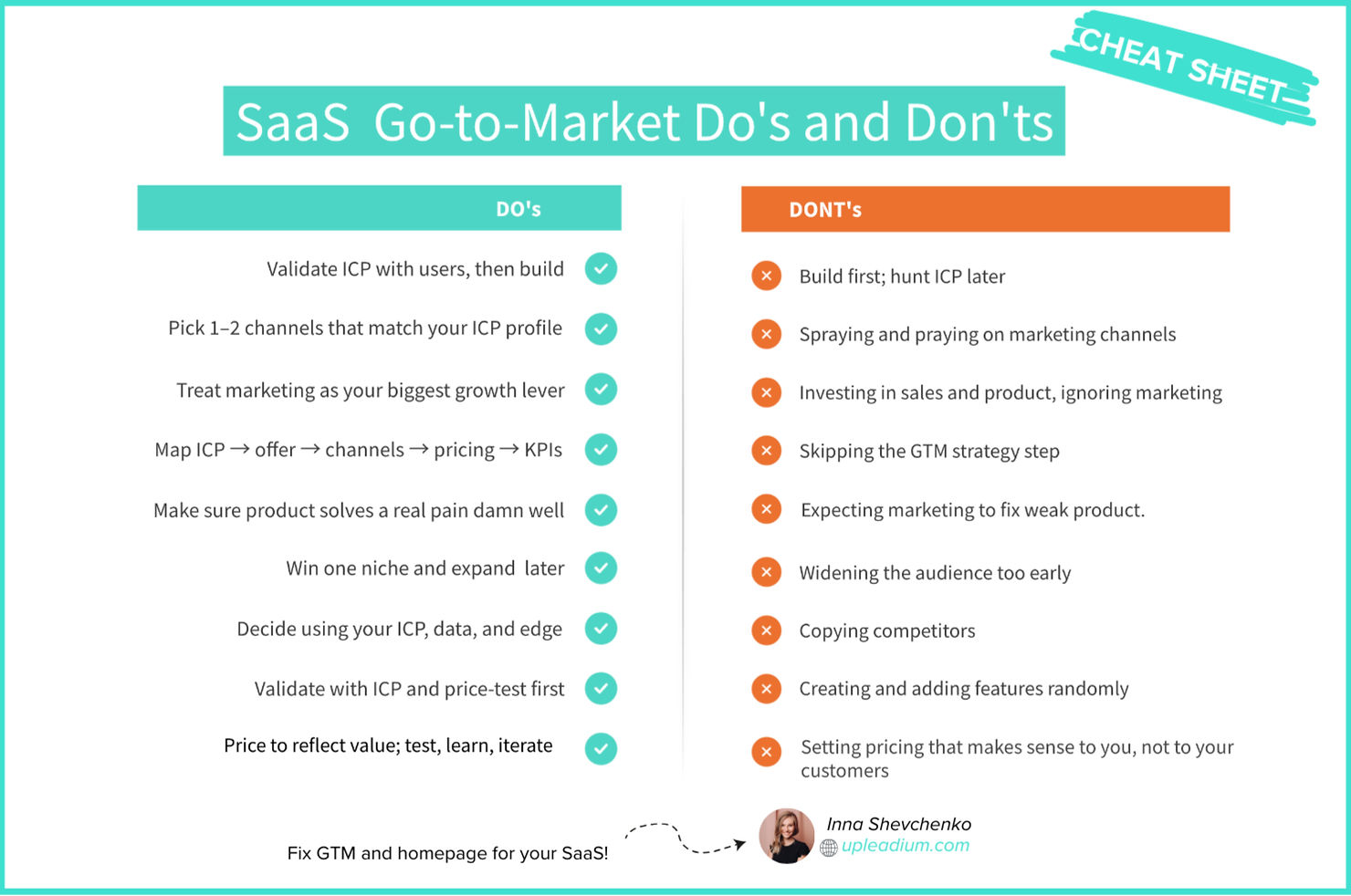
Don’t build first and hunt your ICP later
If you find yourself saying “we will find a market for this later”, pause. You are about to sink time and money into something that might not have buyers.
Flip the sequence:
ICP discovery and validation
Problem and solution testing
Early offer, messaging, and pricing experiments
Deeper product build
Don’t spray and pray across every marketing channel
Being everywhere rarely works if you are early stage.
The signs you are spraying and praying:
You are posting on many platforms without a clear strategy
You keep switching tactics every few weeks
You do not know which channel actually brings customers
Go back to your ICP and pick the 1–2 channels with the strongest signal, then commit to them.
Don’t invest in sales and product while ignoring marketing
If you hire sales reps before you have:
Clear ICP
Strong messaging
A repeatable way to generate demand
Those reps will spend their time building their own lists and experimenting, which is inefficient and demoralising.
Likewise, adding more engineers without a clear GTM plan often leads to feature bloat, not more revenue.
Don’t skip the GTM strategy step
“I know we need a GTM, but we need to move fast” is a trap.
Spending even a focused week clarifying ICP, offer, channels, pricing, and KPIs will save months of random execution later.
Your GTM does not need to be fancy. It does need to exist.
Don’t expect marketing to fix a weak product
Marketing can amplify a good product. It cannot make a weak one stick.
Red flags:
High churn right after onboarding
Customers need heavy manual support to see value
Demos are full of “coming soon” promises
Be honest. If the core product does not deliver, fix that before you step on the GTM gas.
Don’t widen your audience too early
You will feel tempted to broaden your ICP as soon as deals feel hard.
“Maybe this could also work for agencies, and ecommerce, and marketplaces, and…”
This usually dilutes your message and roadmap. Stick with your first niche until you:
Have multiple happy customers there
Understand their buying process
Can close deals with some predictability
Only then test an adjacent segment.
Don’t copy competitors and hope it works
Competitor research is useful. Blind copying is not.
They might:
Have a very different ICP or price point
Be years ahead with brand recognition
Be running experiments you cannot see behind the scenes
Use competitors to understand the landscape, not as your GTM blueprint.
Don’t add features randomly
Adding features “just because customers asked” quickly creates a cluttered product and a confusing story.
Instead, prioritise based on:
Alignment with your ICP’s biggest pains
How often the request appears across accounts
Whether it fits your GTM focus and positioning
Your roadmap is part of your GTM. Guard it.
Don’t set pricing based on what feels right to you
Pricing that “makes sense to you” might be too cheap, too expensive, or misaligned with how your ICP buys.
Test your pricing with real prospects. Ask:
How they compare you to alternatives
What budget line item they would use
What would make the decision easy or hard
Let their feedback shape your pricing, not your internal comfort level.
How To Know If Your GTM Is Working: Metrics And Signals
You do not need an advanced BI stack to know if your GTM is healthy. Focus on a handful of signals.
Early leading indicators
Look for:
Consistent increase in qualified trials or demos from your ICP
Prospects repeating your positioning back to you
Shorter time from first touch to “this looks promising”
Higher activation rates within the first days or weeks of usage
If these are trending up, your GTM is resonating even before revenue fully catches up.
Core GTM metrics
At minimum, track:
Customer acquisition cost (CAC) by channel
Customer Lifetime value (CLTV)
CLTV to CAC Ratio
Payback period on CAC
MRR/ARR growth and net revenue retention
Below you will find relevant benchmarks you might want to explore. To take a look at more metrics, you can read the full Pavilion & Benchmarkit’s 2025 SaaS Performance Benchmarks report.
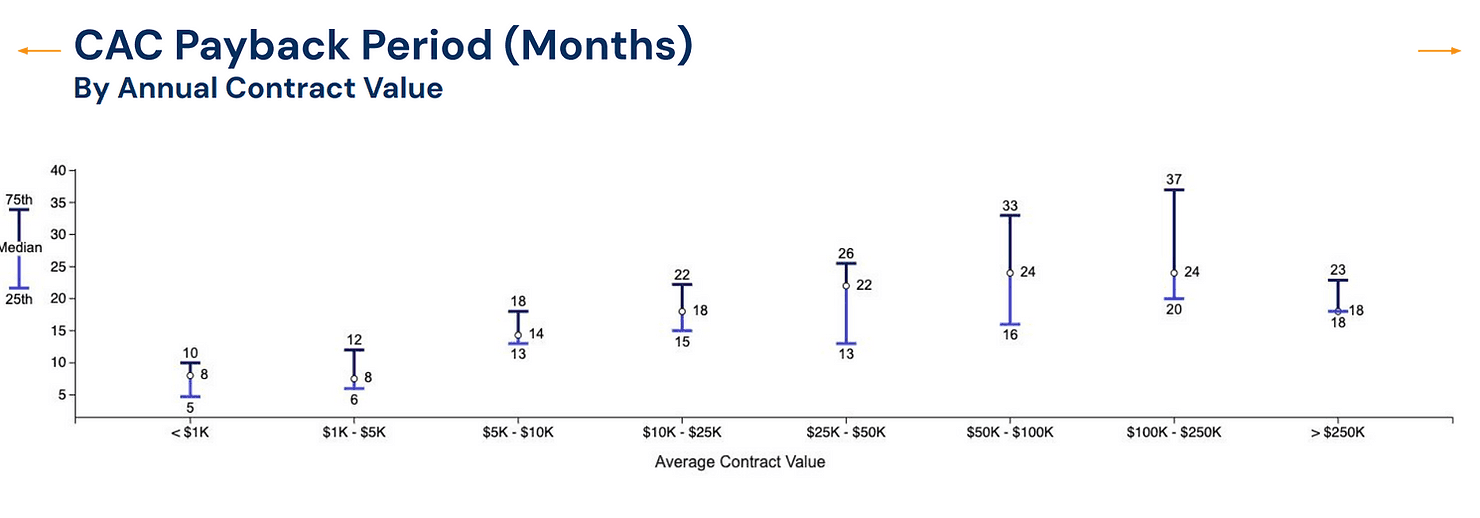
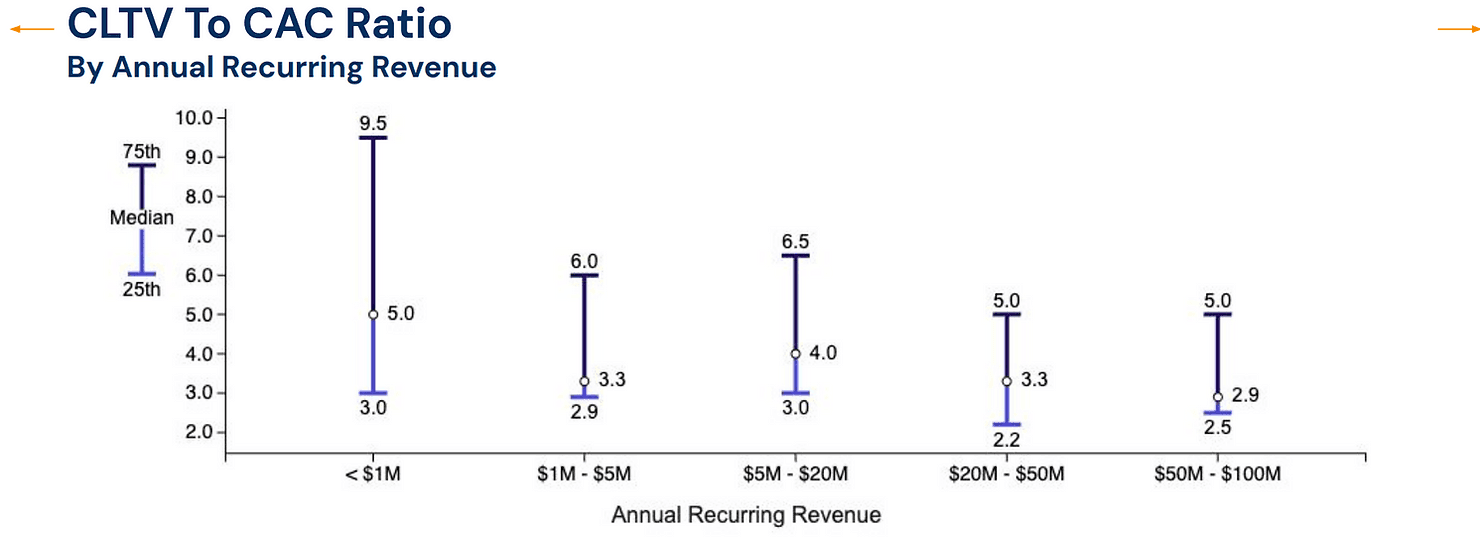
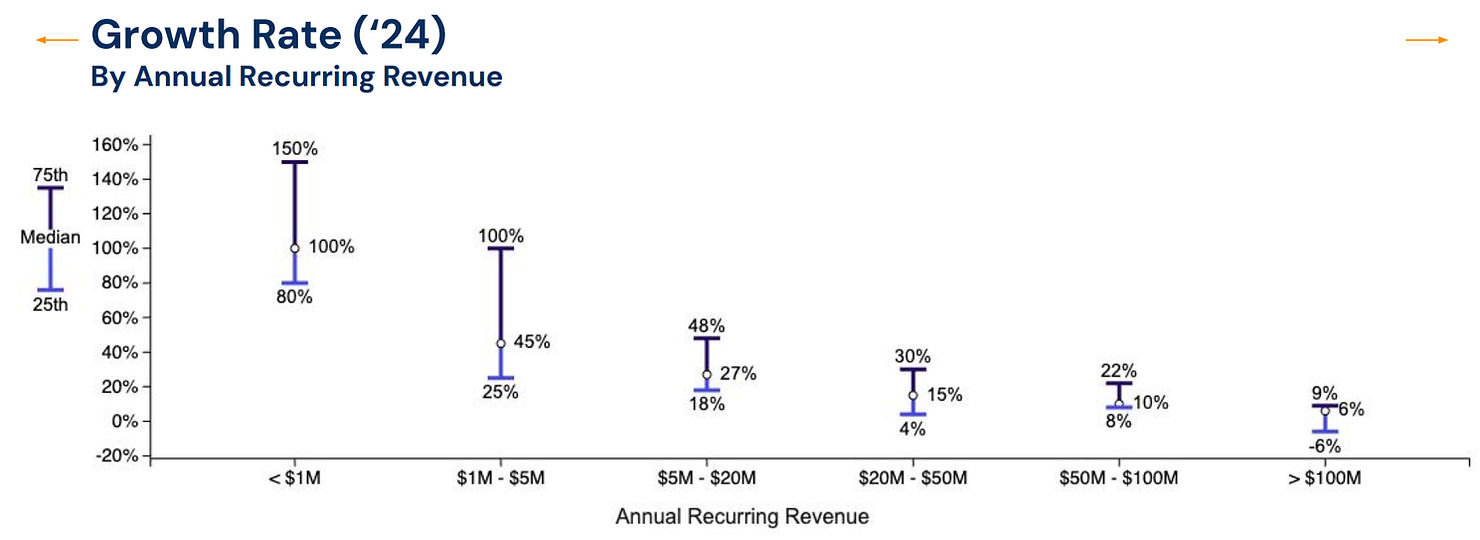
Source: Pavilion & Benchmarkit, 2025 SaaS Performance Benchmarks report.
For an early stage B2B SaaS, the exact numbers will be volatile. The important part is to see whether each new cohort performs better as you refine your GTM.
When to double down vs when to pivot your GTM
Double down when:
A channel consistently delivers ICP leads at a reasonable cost
Your win rate within a niche is climbing
Customers in a specific segment stay longer and expand more
Pivot parts of your GTM when:
You are attracting lots of interest from non ICP segments
Churn is high even with clear onboarding
You cannot get to a reasonable CAC payback in your current channels
A pivot does not always mean a new feature though. Often, it means tightening your ICP, repositioning, or changing how you reach them.
When And How To Expand Beyond Your First Niche
Once your first GTM motion works, the question becomes “what next”.
You may be ready to expand when:
You have strong references and case studies in your niche
You can close deals with some predictability
Your pipeline from current channels is healthy
You start seeing inbound demand from adjacent segments, without actively targeting them
If you still struggle to close your core ICP, expansion will usually make things worse, not better.
Fixing Your B2B SaaS GTM With Upleadium
If you are reading this and thinking:
“Our GTM is not working”
“We are trying too many things and none of them are reliable”
“Our GTM feels like a collection of tactics, not a strategy”
you are not alone. Many good products are stuck in exactly this place.
What I help with B2B SaaS founders
I help SaaS founders to:
Map ICP → offer → channels → pricing → KPIs into a simple, actionable GTM plan
Fix underperforming homepages and key funnel assets
Find the blockers in their GTM and turn them into opportunites.
If you want help building or fixing your go to market strategy for B2B SaaS, the next step is simple:
Book a GTM strategy call and we will walk through where you are, what is blocking growth, and what a focused GTM plan could look like for your product.

SaaS Growth
Marketing Strategy
Discover the 5 key steps for marketing your SaaS startup to success. Learn how to develop a solid strategy and find the right CMO to drive growth.
According to stats, 61% of businesses have more than 100 SaaS apps used by their employees. Great news for SaaS founders, right?
So, your product is already in at least the MVP stage and you are ready to ship it to your customers. Now what?
Marketing your SaaS startup is the next step you want to take to make your product seen and used.
With so many moving parts, it’s crucial to have a solid marketing strategy in place from the start. Based on my experience helping scale SaaS companies, here are the five steps I recommend taking on the marketing front:
1. Hire a Fractional CMO or marketing generalist
One of the first moves any SaaS founder should make is bringing on a Chief Marketing Officer (CMO). Even if it’s only part-time or on a project basis, it’s a smart choice. Having a marketing leader involved from the early days will help you avoid mistakes and use your limited resources wisely.
A fractional CMO makes the most sense in the beginning when budgets are tight. Fractional CMOs are rising in demand as an affordable way to get strategic marketing leadership. Once the business matures you can move to a full-time executive.
Here are five common situations where a fractional CMO can make perfect sense:
You’ve got a killer new product but limited funds for marketing. A fractional CMO is a smart way to get marketing guidance at a fraction of the cost.
You’re gearing up for a big product launch or rebrand - you need marketing help NOW. Fractional CMOs are perfect for time-sensitive project-based initiatives.
Your marketing leader left and you need someone to fill in, fast. A fractional CMO can step into interim executive roles. And hire the team if needed.
You need an audit of what’s working and what’s not. An outside fractional CMO provides an unbiased assessment.
You need to cover startup or small business marketing needs. A fractional CMO provides expertise aligned to your goals and workload. You can hire a growth marketer and a fractional CMO who will guide them and operate on a higher level.
Whichever way you go, fractional or full-time executive, here are the major things you should look for in the CMO:
✅ Focused on Business, not Vanity Metrics. CMO must ask the right questions and focus on the metrics that will drive business forward. It’s not the number of ad impressions, CTR, etc. Instead, it’s MRR (monthly recurring revenue), sign-up to paying customer conversion rate, and CAC (cost per customer acquisition).
✅ Skilled with Content: A seasoned CMO needs strong writing skills. Marketing revolves around creating content that resonates across channels, so this executive must be adept at crafting compelling copy that delivers value to readers. An effective CMO understands the difference between fluffy content that falls flat and impactful content that truly connects with the target audience.
✅ Customer-Centric: A CMO should be the bridge between your brand and your customers. They should understand what makes your customers tick.
✅ Strong Prioritization Skills: A great CMO can cut through the noise and focus on what matters.
✅ Doer Personality: A CMO with a doer personality doesn’t just sit in the strategist’s chair. They roll up their sleeves and get their hands dirty.
✅ Lead by Example: The doer CMO leads by example. They don’t just delegate, they show. This personality trait fosters a culture of action within the marketing team. When challenges arise, the doer CMO is right there with the team, navigating through obstacles.
✅ Agility and Adaptability: They embrace change and quickly adapt to new trends and technologies.
✅ Results-Driven Mentality: While strategic thinking is crucial, a doer CMO is focused on results. They understand that marketing is not just about creating impressive plans. It’s also about executing them effectively and quickly.
2. Put Together a Go-To-Market Strategy
One of the first tasks your CMO or head of marketing should focus on is developing a thorough go-to-market (GTM) strategy. In other words, it is a plan of how you will get your SaaS in front of customers and convert them into paying users.
The GTM strategy document should cover 9 key elements required to launch and scale the SaaS business. It should be well-thought-out yet concise, articulating the growth strategy. Let’s go through the main parts of the GTM strategy.
🎯The Product and Offering section should describe the product features and how they address customer needs. You should be able to define the unique value proposition and outline the planned product roadmap.
🎯The Messaging and Positioning section covers messaging that should resonate with target customers. First, create an ideal customer profile and buyer personas. Then align branding and messaging to the product’s value. As a next step, write a unique market positioning statement.
🎯The Market Research section is about the addressable market size, trends, and competitive landscape. Segment the target audience into categories and research competitors’ messaging, pricing, etc. If you are just starting, plan how you will validate the need for your product. A study by CB Insights revealed that 42% of SaaS startups shut down due to “no market need” for their product. So, prove that you have a high chance of finding your product market fit before investing too much in the idea and marketing.
🎯The Pricing section is for choosing a suitable pricing model aligned to the product. Plan pricing experiments (at least 2 per year) to uncover opportunities and test different approaches.
🎯The Customer Engagement section explains the onboarding process and describes the customer support channels and the customer success plan.
🎯The Go-to-Market Motion section is designed to describe the approach you take to deliver your product to the audience. Product-led motion is suitable for products with easy self-guided adoption through intuitive design. Sales-led motion is usually a good fit for complex enterprise products. Sometimes a mixed approach that blends both is a way to go.
🎯The KPIs & Analytics section must identify key performance indicators and how you will measure those. Make sure to set specific, challenging yet achievable targets and benchmarks.
🎯The Marketing & Sales section specifies marketing channels, budget, priorities, and the marketing team’s key focus areas. Also, it makes sense to map out the sales process and funnel stages.
🎯The Timeline section provides an implementation plan with responsibilities, milestones, and a risk assessment.
When filling out the sections, keep the end customer in mind. Map everything back to understanding and meeting their needs. Discover more about GTM strategy and how to create one in this guide.
3. Set Up Analytics and Attribution Models
One mistake some SaaS founders are making is launching marketing without setting up the analytics. Analytics and attribution are essential for assessing the impact of your activities and optimizing your strategy.
Start by setting up Google Analytics, as well as any other analytics tools needed for your website, apps, or platform.
The ideal option would be to connect all your data to BigQuery including marketing results and stats from the product.
Establish key dashboards and reports to monitor traffic, engagement, conversions, and more. You can put them together using free tools like Google Sheets or Looker Studio.
You also need to determine how you will track ROI and attribute conversion value to different campaigns and channels. For accurate multi-touch attribution, I recommend using platforms like HockeyStack. This will let you see the true impact of each marketing touchpoint in driving sign-ups and revenue.
Be rigorous about analyzing performance and setting optimization goals. Continuous improvement will be vital for marketing success.
4. Map Out a Marketing Roadmap
Once you nailed the strategic foundations, I recommend creating a high-level marketing roadmap. It lays out objectives, marketing channels, and KPIs. The roadmap should map out key activities across channels and campaigns over the next 3 or 6 months.
It should have concrete goals and key results to hit by specific dates. I’m a big fan of the OKRs (objectives and key results) goal-setting. It helps to align everyone on priorities. Don’t be over-obsessed with the planning though, your roadmap and marketing approach should be flexible.
What should a marketing roadmap contain?
Here’s a list of essentials to cover in your marketing roadmap:
General business marketing goals (this is where our North Star Metrics live).
Marketing budget by channel and by month.
Marketing channels with key target metrics.
Visual roadmap of key marketing activities for the period. Make sure to map out vital campaigns, promos, or events that support major launches.
Potential risks, limitations, or dependencies that could impact delivery.
Chose your key marketing channels
The key question that all SaaS startups face is how to choose those first marketing channels. Based on my experience with SaaS startups, I have created this chart. Hopefully, it will give you an idea of what popular marketing channels have in store.
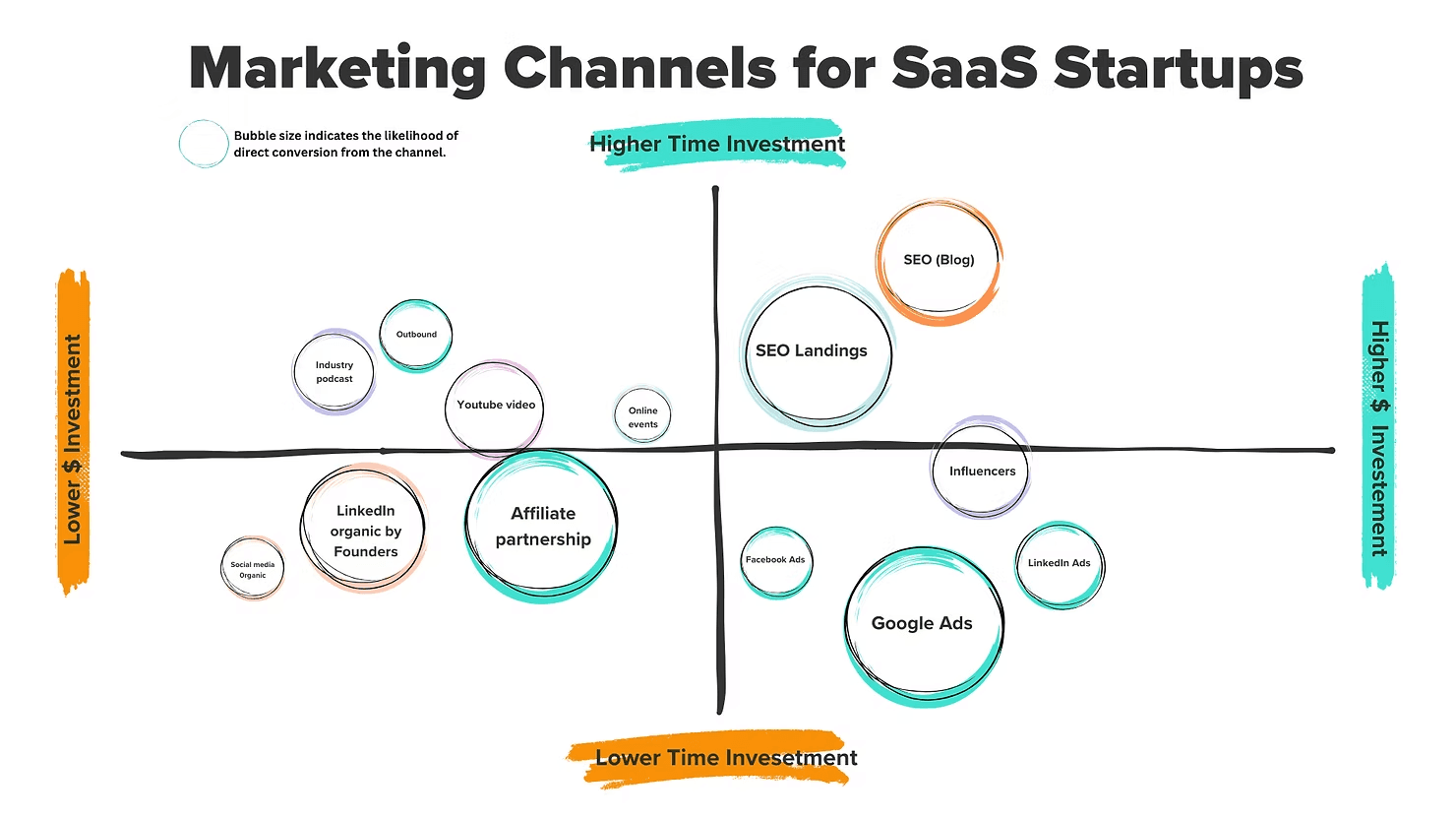
It shows how much time and money each channel relatively needs. Also, based on results I’ve seen in the past with other SaaS startups, I represented each channel with a bubble of different sizes. The bigger the size - the higher the likelihood of direct conversion from the channel.
Don’t get carried away and try all the marketing channels at once. With limited resources, you have to be selective in choosing only several to focus on at first.
5. Define First Month Priorities for Marketing Your SaaS Startup
While you need a long-term roadmap, first-month priorities are critical for making an immediate impact.
Activities you could focus on for quick wins could include:
optimizing the website for conversions,
launching targeted LinkedIn campaigns to reach your ICP,
developing compelling content that speaks to your customers’ needs.
Get very granular on defining each team member’s responsibilities for month one.
Pro Tip: use the RASCI model to assign clear owners to each task and avoid duplication.
The first month or two is all about getting some quick traction and proving your model. By pressing hard on those month-one priorities, you can generate momentum going into the rest of your marketing roadmap.
5 Tips for Marketing SaaS Startup
Often what many startups THINK THEY NEED is not necessarily what they ACTUALLY NEED. Here’s my list of 5 tips to be one step ahead.
🔴 Forget “marketing growth hacks”; build a solid GTM strategy, and use working frameworks. This is a true roadmap for success, while shortcuts often lead to dead ends.
🟣 Don’t fall into the trap of omnipresence. Spreading yourself thin across every channel is resource-intensive and ineffective. Choose several specific channels and dedicate quality time to them for optimal results.
🟢 Exceeding competitors isn’t always necessary. Being different can be just as powerful. Make your product distinctive.
🟡 Focusing on perfecting your product is not as important as being quick and addressing your customers’ feedback. Embrace continuous product evolution and focus on solving real problems for real people.
🔵 Instead of seeking a “Marketer-Magician,” look for a seasoned practitioner with T-shaped skills and a proven track record in scaling startups. They’ll understand that “exponential growth” requires more than just paid ads and that a half-baked product won’t generate sustainable results.

Need Help with Marketing SaaS Startup?
With 8 years of helping SaaS startups go from 0 to $3M ARR and more, I’ve started Upleadium to help more businesses with my services. Here’s what I can offer:
🟢 Marketing Audit & GTM Strategy: I conduct a comprehensive audit of your current marketing strategy and programs. Then I develop an optimized go-to-market strategy tailored to your business goals. This includes positioning, messaging, and a roadmap to drive results.
🟢 Fractional CMO services: I can serve as your part-time Fractional CMO to oversee marketing strategy, drive execution, and provide ongoing growth consulting. This allows you to tap into high-level marketing expertise without the cost of a full-time CMO.
🟢 Marketing Consultations: Get help with specific marketing questions or projects through one-time or ongoing consultations. I’ll provide strategic guidance to unblock growth.
🟢 Website Messaging: I’ll align your website messaging and design with your value proposition for maximum impact. Includes strategy, wireframes, and copywriting.

Go-to-Market
SaaS Growth
Explore this guide to understand what a SaaS GTM strategy is, when you need it and how to create it so that it helps you reach business goals.
The Complete Guide to SaaS Go-to-Market(GTM) Strategy in 2026
A rock-solid go-to-market (GTM) strategy is essential for SaaS companies looking to successfully launch and scale their products. With rising customer expectations, a solid data-driven and customer-focused GTM plan is not something that can be overlooked by organizations any more. This guide will provide you with an understanding of what a GTM strategy is, what it is not, when you need it and what it includes. Let's dive in!
Need help crafting a GTM strategy for your SaaS startup? Explore Upleadium's GTM consulting services to arm your business with a comprehensive plan to reach your goals.
What is a GTM Strategy for SaaS?
A GTM strategy is a detailed plan that outlines how a SaaS company will introduce their product to the market. It covers the strategic pillars of positioning, product marketing, pricing, sales motions, and customer engagement required for market success.
The ultimate goal of a SaaS GTM strategy is to maximize adoption, conversion, and expansion in the most efficient way possible. It enables cohesive planning across functions like Product, Marketing, Sales, and Customer Success. It’s also important to understand what a GTM strategy is not.
What a GTM Strategy is Not?
A go-to-market (GTM) strategy is sometimes confused with other business planning activities, but it has a distinct focus all its own. Here are some of the most commonly misinterpreted activities that are often mistaken for a GTM strategy:
Product roadmap:
While a product roadmap details the vision and direction of your product over time, a GTM strategy is more focused on marketing, distribution, pricing, and more.
Marketing strategy:
While they might seem similar, a GTM strategy encompasses more than marketing. It also includes sales strategies, market research, pricing, and customer engagement among other things.
Business plan:
A GTM strategy is a component of a business plan, but they are not the same thing. A business plan is a broader document that outlines your business's overall mission, goals, and how you plan to achieve them.
Sales strategy:
While sales strategies are a part of a GTM strategy, the latter covers more ground. It's not just about how to sell the product, but also about how to position it, price it, and market it.
Why You Need a GTM Strategy for Your SaaS Business
While execution is the key, careful strategic planning is the foundation of your lasting success. A strong GTM strategy is required to:
Keep focus and have all the stakeholders aligned on common goals.
Generate awareness and trials for a new SaaS product launch. Without a solid plan to cut through the noise, new products can easily get lost in a crowded market.
Drive adoption and retention when releasing updated versions. Version launches need coordinated messaging to highlight new capabilities and encourage renewals.
Enter and win in new verticals or geographies. Customizing positioning and sales motions is vital to land new segments.
Pivot messaging and positioning to find product-market fit. Testing and optimization is easier with an integrated GTM framework.
Scale efficiently during high growth periods. Cross-functional alignment ensures consistent customer experiences at scale.
As Redpoint Ventures Managing Director Tomasz Tunguz notes, "88% of startups fail due to lack of market need. An insights-driven GTM strategy is key to ensuring you’re solving real customer pain points."
When to Create Your SaaS GTM Strategy
GTM strategy is not one and done type of documents. At different stages SaaS companies usually review it, make adjustments so it guides them through new challenges and leads to new wins. Typical scenarios where SaaS companies need to formulate or reevaluate their GTM strategy include:
Launch of a New Product
A Go-To-Market (GTM) strategy is crucial for a SaaS product launch since it provides a structured plan to identify and reach the target audience effectively while positioning the product in the market. It also guides pricing, marketing, sales, and post-launch support efforts, ensuring a coordinated and successful introduction of the product. Getting positioning, messaging, and motions right from the start increases launch success.
Launching a Significant New Release (v2.0, v3.0 etc.)
Major version updates require coordinated strategies to showcase new capabilities via updated branding, messaging, features list, and sales collateral. When updating a product, a GTM strategy helps re-engage existing customers and communicate new features effectively.
Entering a New Market Segment
Adjusting tactics and positioning for new buyers requires an updated strategy. For example, launching SMB vs. Enterprise may need modified packaging, pricing, and sales plays.
Switching ICP while Finding Product-Market Fit:
Testing new ICPs( Ideal Customer Profiles) or adding more ICPs calls for going back to the drawing board on product-market fit. Running through the paces again to align the product with the new target customer's needs and pain points is crucial. Make sure to get feedback from your customers on this stage as much as you can.
Planning for Rapid Growth and Scale
When growth goes through the roof, having a plan for scaled execution is key to ship shape operations. For example, reworking sales territories, adding product/pricing tiers, and ramping up marketing spend across channels. Reviewing GTM strategy at this point ensures quality isn't lost even in hyper growth mode.
Responding to New Competitive Threats
Being nimble in response to market threats is key to sustainable growth. When disruptive competitors enter the playing field, adapting your GTM strategy may be necessary. For example, emphasizing your product's differentiating strengths over the new competitor's offerings. Or revisiting pricing and packaging to stay competitive.
SaaS GTM 101
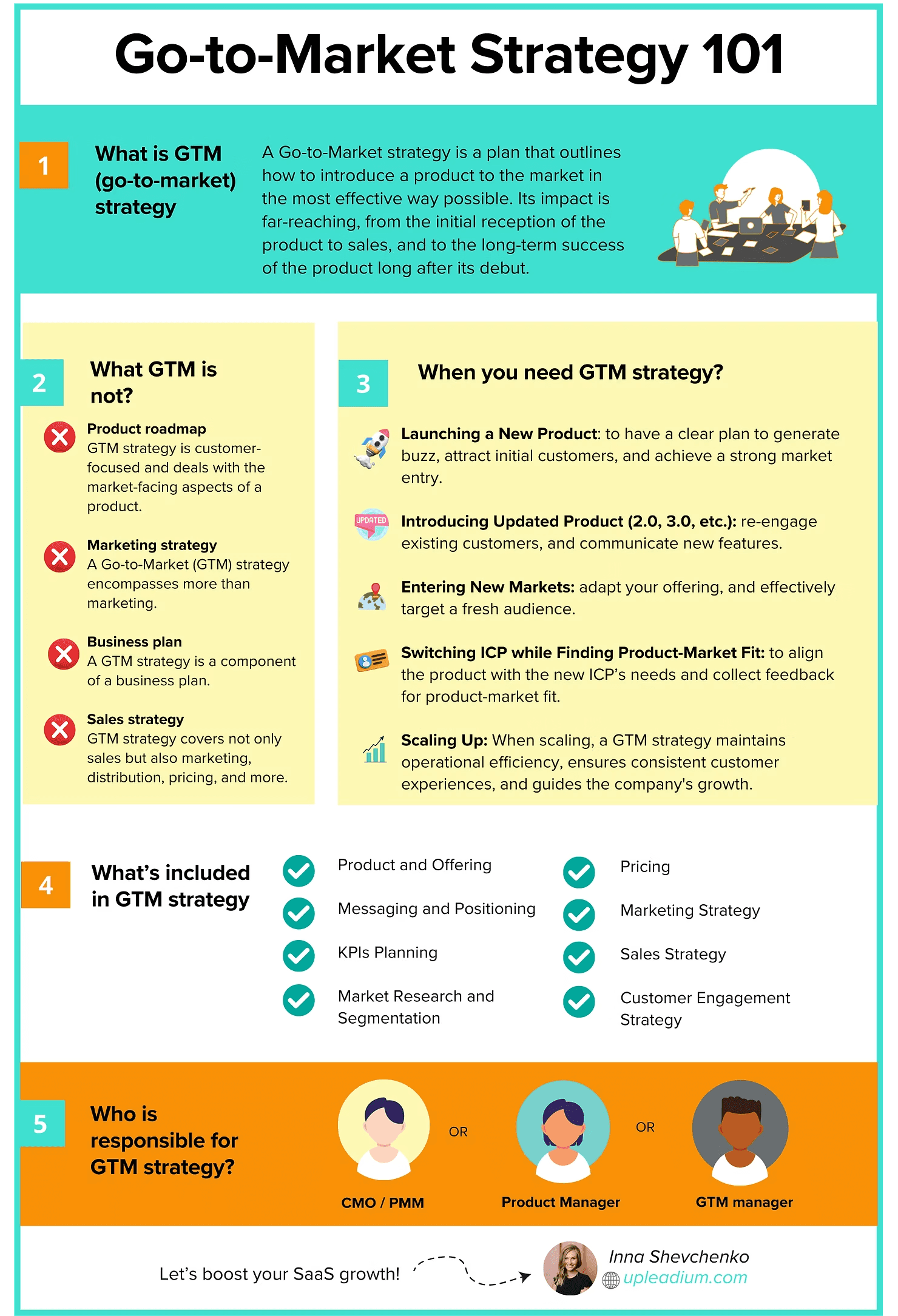
9 Key Elements of a SaaS GTM Strategy
In crafting a successful Go-to-Market (GTM) strategy for your SaaS startup, understanding the key elements and the role they play is essential. Each element contributes to the overall roadmap, defining how your product enters the market, engages customers, and drives growth. Let's explore these crucial components in detail.
1. Product and Offering:
In this section you need to clearly define how your product stands out and the value it offers your ideal customer. Make sure to include:
Product offer: Description of your SaaS product, its features, and how it addresses market needs.
Value Proposition: Define what makes your product unique and the value it brings to customers.
Product Roadmap: An outline of planned product enhancements and features.
2. Messaging and Positioning:
The main objective of this part is to craft product narrative and communication that resonates with your audience. These are the major components to add:
ICP (Ideal Customer profile) & Buyer Personas: Profiles of your ideal customers, including their pain points, preferences, and behaviors.
Brand vision and mission: How your company's vision and values aligns with the product's value and resonates with your audience.
Positioning: A concise declaration that highlights your unique position in the market.
3. KPIs and Analytics:
Set performance benchmarks (north star metrics) and strategically analyze results. With that said, this section will cover:
KPI Selection: Identify which key performance indicators are most relevant to your goals (e.g., conversion rates, customer acquisition cost, churn rate).
KPI Metrics: Define how each KPI will be measured and reported.
Targets and Benchmarks: Set specific, achievable targets and compare them to industry benchmarks and your previous results.
4. Market Research and Segmentation:
Understanding your market, competition, and ideal customer is an essential section of the GTM strategy to paint the landscape. So, here’s what you need to do:
Market Analysis: Insights into market size, trends, and competitive landscape.
Segmentation: Categorize your target audience into distinct segments based on demographics, behavior, and needs.
Competition overview: Check out direct and non-direct competitors messaging, pricing, marketing channels to understand your niche dynamics.
5. Pricing:
Pricing is one of the elements that can make or break your whole GTM strategy altogether. Proper pricing will define if the value of the product is adequate compared to how much it costs. This section can contain the following:
Pricing Model: Choose the pricing structure that aligns with your offering (e.g., subscription, freemium, tiered).
Pricing experiments: If it’s not a new product that you offer and your pricing structure will most likely stay as is, plan experiments that you can run with pricing to open new growth opportunities.
6. Marketing & Sales Strategy:
Plan marketing channels and major marketing tactics effectively to make sure you find your target audience in the right place to offer them your product. Once the product is available on the market, your sales team also needs to know their drill. Therefore, don’t forget to
Promotion Channels: Specify which marketing channels (social media, content, email, PPC) you'll use and their priorities and budget.
Key focus priorities: what will the marketing team concentrate on to reach business KPIs set in the GTM strategy.
Sales Process: Describe the stages of your sales funnel and how leads progress through it.
7. Customer Engagement:
Customer acquisition is just a first step that users take to interact with the product. While getting users to sign up is important, keeping them within your product for activation and retention is key to healthy product metrics and your launch success. Make sure you plan:
Smooth Onboarding Process: Explain how customers are onboarded to your product.
Customer Support Channels: Describe the support channels available to customers (e.g., email, chat, phone).
Customer Success Plan: Outline how you'll help customers achieve their goals.
8. GTM Motion:
The Go-to-Market (GTM) motion refers to the approach and tactics a company uses to take its product or service to the market. It plays a significant role in how you engage with customers and drive growth. GTM motions can be categorized into three primary models: product-led, sales-led, and mixed. Let's explore each of these and when they are best to use:
1. Product-Led GTM Motion:
When to Use: This approach is ideal when your SaaS product is intuitive, easy to adopt, and capable of selling itself. It's especially effective for freemium or self-serve SaaS offerings.
Planning: Focus on product design, user experience, and providing a seamless, self-guided onboarding experience. Implement in-app marketing, product tours, and automated email nurturing to guide users to value quickly.
2. Sales-Led GTM Motion:
When to Use: The sales-led approach is best when your SaaS product is complex, requires customization, or targets enterprise customers. It often involves high-touch sales interactions.
Planning: Build a strong sales team and define a clear sales process. Develop detailed buyer personas, and align your marketing efforts to generate qualified leads for your sales team to engage with.
3. Mixed GTM Motion:
When to Use: The mixed approach is a blend of both product-led and sales-led strategies. It's suitable when you have a diverse customer base with varying needs, and some segments can benefit from self-service while others require personalized attention.
Planning: Segment your customer base and tailor your GTM strategy accordingly. Invest in both product-focused initiatives (e.g., product tours and educational content) and a sales team for high-touch engagement.
9. Planning / Timeline
This section outlines how you'll execute your strategy, establish milestones and timelines, and proactively address potential challenges, ensuring a smooth path toward your GTM success. Make sure to include:
Implementation Plan: Specify how you'll execute the strategy, including who is responsible for each task.
Milestones and Timelines: Set clear milestones and deadlines for strategy execution.
Risk Assessment: Identify potential obstacles and how you plan to mitigate them.
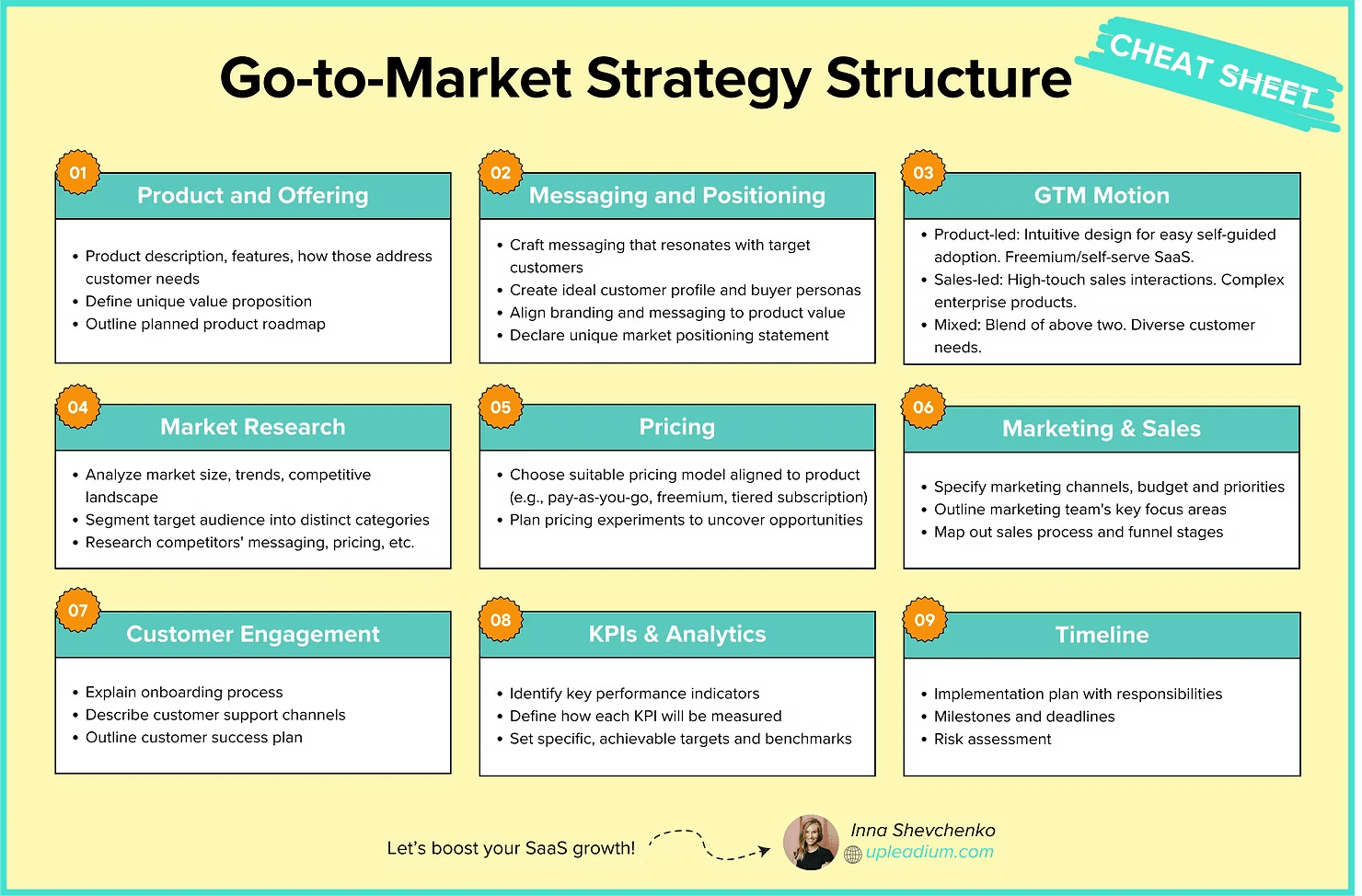
The GTM strategy document should provide a detailed roadmap for each of these sections, complete with objectives, tactics, and key milestones. It should serve as a comprehensive guide for your team to follow and execute the strategy effectively.
With all the sections mentioned above, how can your team be sure that your GTM strategy is well developed? The hallmarks of an effective GTM strategy include the following characteristics:
Customer-centric: Focused on solving buyer needs better than alternatives.
Focused - Don’t plan too many tactics and spread yourself thin to try out everything at once. Stay focused to achieve the best outcome.
Feasible - While setting challenging goals keeps motivation up, your KPIss need to be achievable for the team.
Aligned across functions: Sales, Marketing, Product, CS should be working together to accomplish the plan.
Data-driven: Quantifiable KPIs guide decisions and optimization should be in the center of your strategy.
A robust GTM strategy is crucial for successfully introducing your product or service to the market. It can be the difference between a successful launch and a failed one. So, let's boost your SaaS growth with a solid GTM strategy!
let's get started
Your website can convert better.

let's get started